
Thoughts on the KOSPI Crash and Fair Value

The Korean stock market has recently plunged. It was a correction large enough to trigger a selloff cycle for the first time in 4 years and 5 months. It was a truly frightening decline. There is a stock market adage: "Buy in fear." But what matters more than that is whether you are buying at a price below fair value. As Howard Marks advises, buying cheaply completes half of investing. So the next question is whether the Korean stock market is cheap enough to buy now.
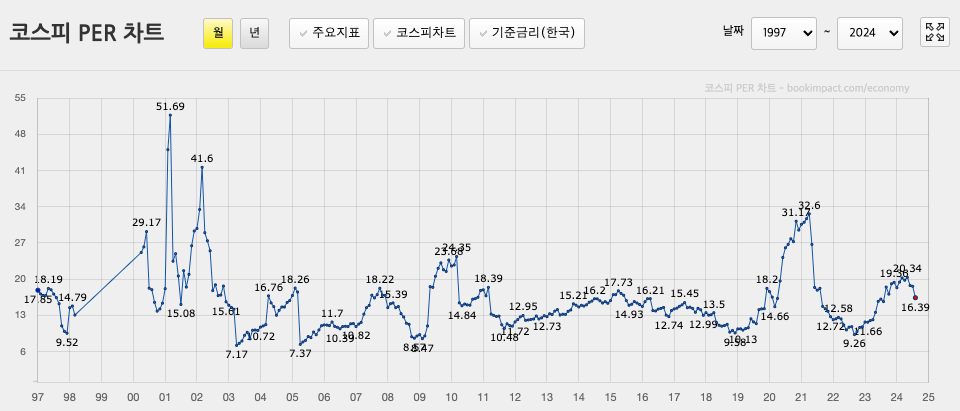
According to data from Bookimpract, the Price-to-Book Ratio is relatively low, but the Price Earnings Ratio is not at a low level. In fact, the 20-year average was 14.87, and the 10-year average was 15.80. However, one thing worth noting is that in May 2022, the PER was 12 even though the KOSPI was at 2,600 points. In other words, it was higher than the August 6 closing price of 2,500, yet the PER was higher. That means companies' net profits have declined over the past two years. Even if the PER is high, considering macroeconomic factors, it was a cyclical bottom.
Is It Cheap Enough Compared to Other Countries?
The markets most often mentioned as undervalued recently are China and Hong Kong. Simply approaching a comparison with these countries by PER alone is difficult because Chinese stocks have also been very cheap recently. Since it is hard to compare PERs across countries on an equal footing, I referred to MSCI indicators as a benchmark.
| MSCI Index | PER | PBR | Dividend (Trailing 12 Months) |
|---|---|---|---|
| MSCI China (MCHI) | 9.49 | 1.47 | 2.80% |
| MSCI Hong Kong (EWH) | 12.82 | 0.79 | 5.11% |
| MSCI Korea (EWY) | 8.85 | 1.09 | 2.47% |
By both PER and PBR standards, the Korean index was the most undervalued. Compared to the KOSPI, the MSCI invests in only 105 top large-cap stocks and has a high weight in Samsung Electronics, Samsung Electronics preferred shares, and SK Hynix, so its PER was assessed as relatively lower. Meanwhile, MSCI China had a high weight in IT and commerce companies such as Tencent, Alibaba, and Pinduoduo. Lastly, the Hong Kong ETF had a high weight in insurance company AIA and the Hong Kong Exchange.
Can We Expect the Next Cycle?
The Korean stock market is most closely related to semiconductors, while the Chinese stock market is deeply related to e-commerce and China's domestic market. Looking at the AI boom, semiconductor cycles are relatively less tied to the business cycle, whereas the Chinese stock market can be seen as heavily influenced by the U.S. interest rate cycle and the political environment. Therefore, investing in the Chinese stock market also seems like a good choice. In addition, the Chinese stock market has recently seen more foreign money outflows and more subdued domestic demand than Korea, so it is likely to experience a bigger upside cycle in the future.
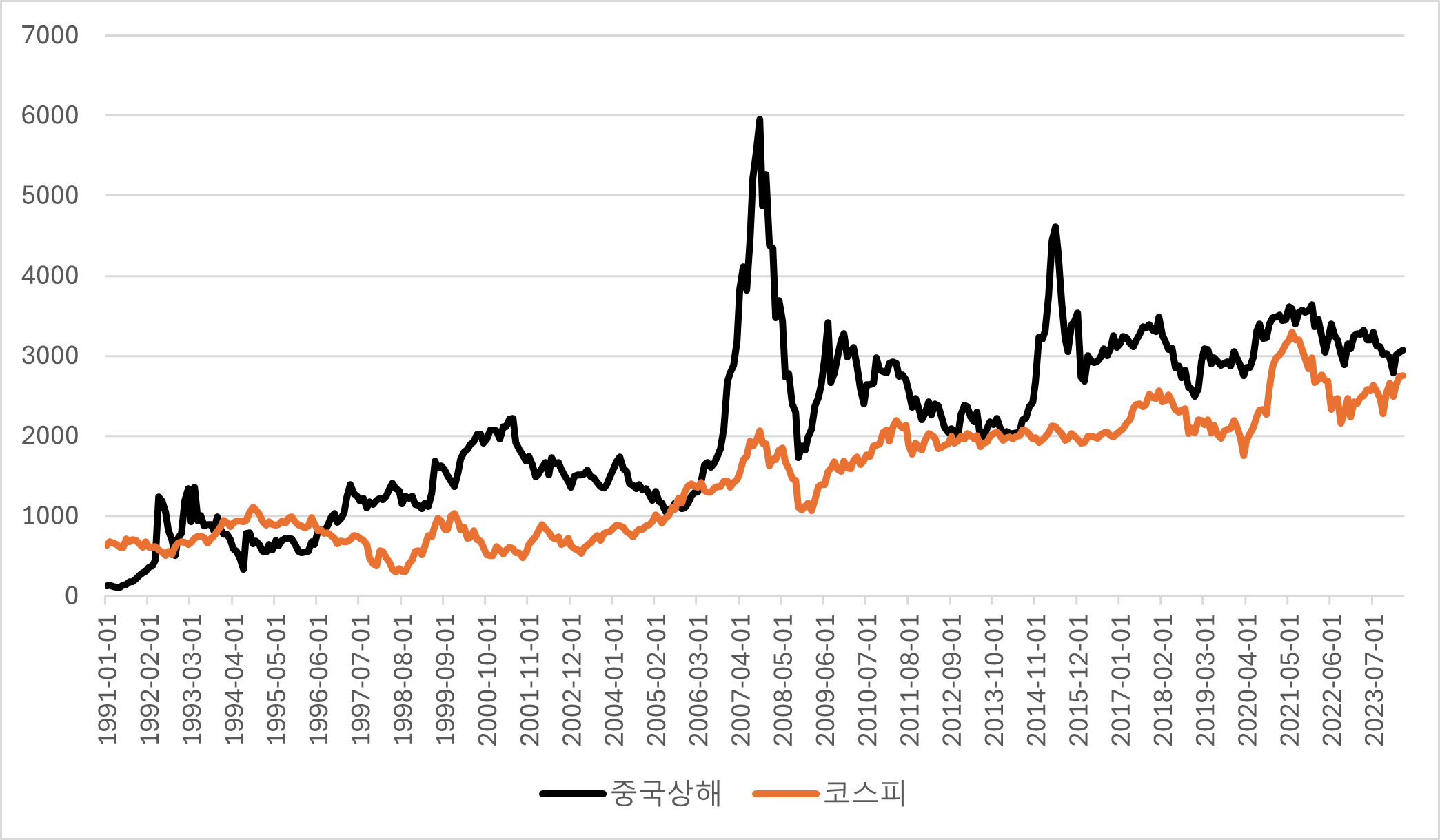
However, looking at the movements of the Chinese and Korean stock markets so far, the correlation between the two has been quite high.
What Is the Alternative to MSCI Korea?
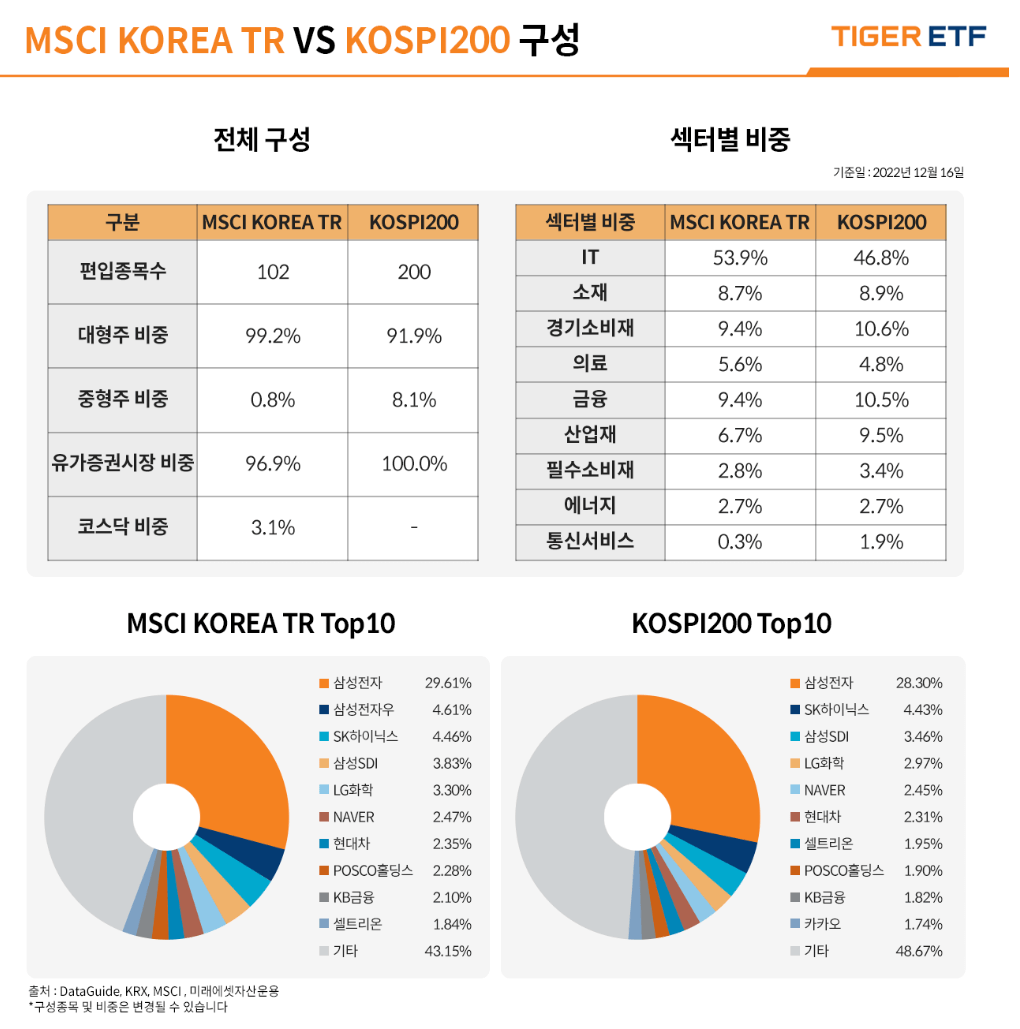
If you invest in the Chinese stock market, you cannot ignore the 22% capital gains tax. Therefore, if you are going to invest in the Korean stock market, the KOSPI 200 is the closest composition to the MSCI in Korea, and if you want to invest fully in the MSCI index, it would be better to invest in ETFs offered by domestic securities firms, such as MSCI KOREA TR. However, KOSPI 200 ETFs are far cheaper in terms of cost.
Like the Korea discount, could it be that instead of reflecting cash as profit, it is accounted for as retained earnings, so the Price Earnings Ratio does not rise and only the Price-to-Book Ratio goes down?
Related posts
Ace Bed Company Analysis
Ace Bed is a premium bed brand focused on the domestic market, with a very stable financial structure and debt-free management, maintaining a high dividend yield (5.71%). ROE is decent, but capital efficiency is low due to excessive cash holdings. The owner family's stake exceeds 80%, and maintaining the listing appears to be largely for management succession. Short-term surges are difficult, but long-term investment appeal still exists.
The High-Dividend Trap
'High-dividend' stocks are not always a good choice. A high dividend payout ratio means lower long-term growth, and receiving dividends every year eliminates the tax deferral effect. Caution is needed because the dividend may not be sustainable or the company may have low growth potential.
Is Trump Really a Successful Businessman President? (Feat. 6 Bankruptcies)
Trump has packaged himself as a successful businessman, but in reality he has experienced six bankruptcies, and most of his assets were inherited from his father. He repeatedly faced crises through excessive leverage and reckless investments, and in 2024 faced yet another crisis due to inflating his assets.