
Ace Bed Company Analysis
The reason I became interested in Ace Bed was the thought, "You have to lie on a bed before buying it." When I lived alone, I had strong faith in Zinus. But the more bed stores I looked around, the more I felt Ace Bed's stores were clearly much better. If Ace Bed's stores were luxury boutiques, Zinus felt like just a concept store. The quality of the staff and customer service was also very different, but I still bought a premium bed from Zinus, which is only sold in stores.
But the result was even worse—I received delivery at a truly insulting level. Since Zinus beds are sold only via parcel delivery, they just called a courier driver. It was awful. I paid so much money... I think that's when I became interested in Ace Bed.
Ace Bed, the No. 1 player in the domestic bed market, has been confirmed to be taking steps to liquidate its Chinese entity. Following Italy, it is fully withdrawing from the Chinese market as well.
First of all, Ace Bed's sales come almost entirely from Korea. There is almost no export. 99.9% is generated domestically (Ace Bed Business Report 2024.12, Business Overview). In contrast, Zinus's overseas revenue share is 95.3% (Zinus Business Report 2024.12). It is an extreme difference. The company expanded its China business in the 1990s and 2000s, but when it produced little fruit, it neatly shut it down and exited.
Once a COVID-19 beneficiary stock
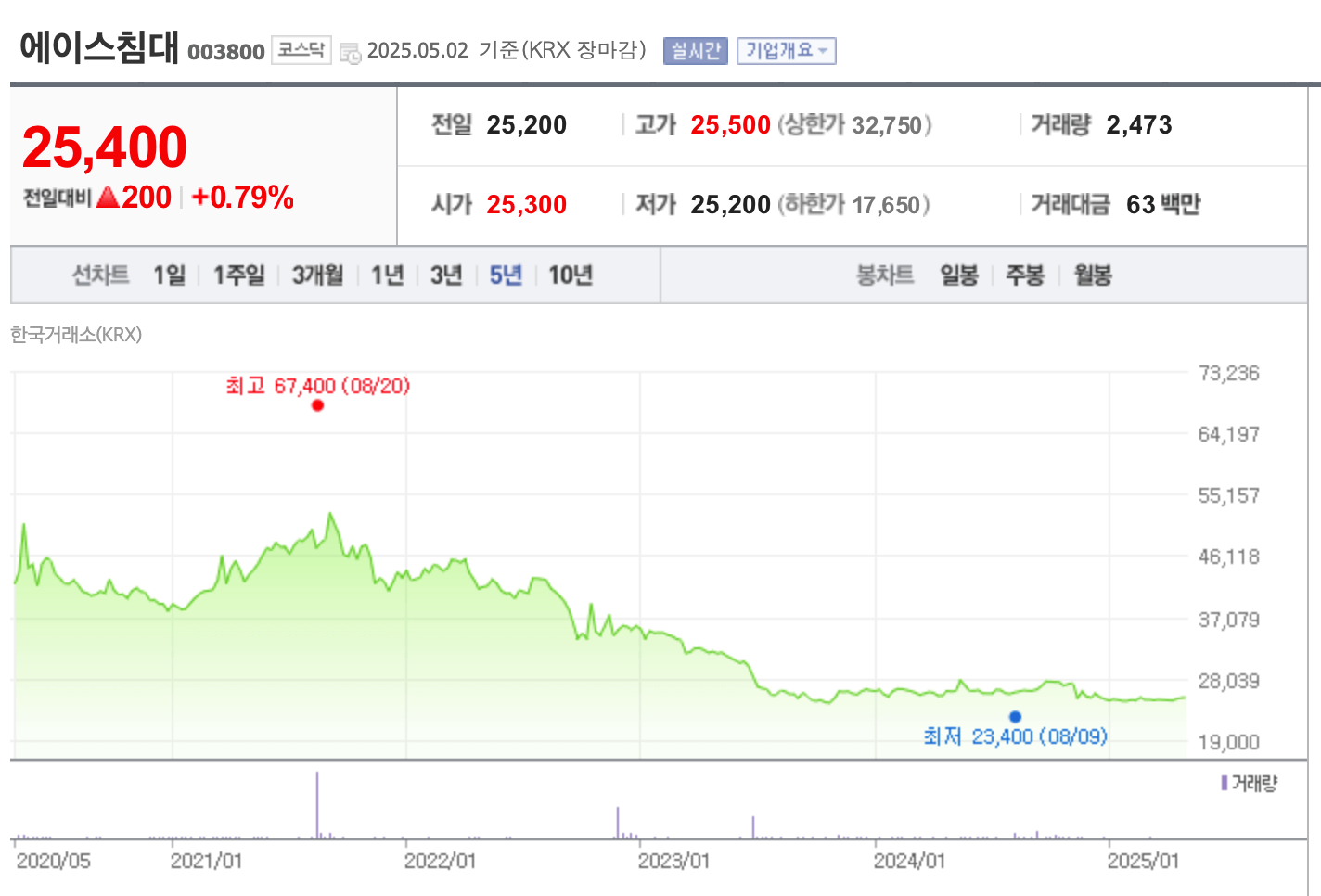
As real estate prices rose due to COVID-19 and moving picked up in earnest, the stock once hit KRW 67,000. Now, with apartment transaction volumes declining, it has faded somewhat. However, I think apartment price volatility will be very large going forward, and that people will prefer "small homes" over "big, nice homes" while pursuing healthier lives, so I view the industry positively. And this stodgy bed business is exactly the kind of boring sector.
How are the earnings?
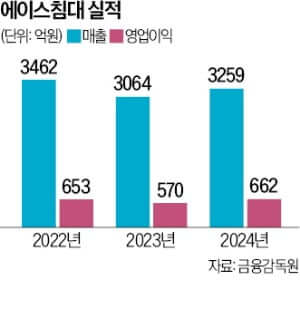
| Unit (KRW 100M) | Revenue | Operating profit | Operating margin | Net income |
|---|---|---|---|---|
| 2024/12 | 3,259 | 662 | 20.31% | 659 |
| 2023/12 | 3,064 | 570 | 18.60% | 514 |
| 2022/12 | 3,462 | 653 | 18.86% | 544 |
| 2021/12 | 3,463 | 767 | 22.15% | 638 |
| 2020/12 | 2,894 | 493 | 17.04% | 493 |
Source: Ace Bed Business Report (2024.12) Consolidated Financial Statements, Naver Finance Company Performance Analysis
Operating profit and revenue are almost constant, with no major changes. ROE is 8–10%, quite high for a manufacturer, and despite rising interest rates, ROE has actually increased—likely because there is no borrowing—improving capital efficiency. Moreover, since the company's debt is less than 10% of assets, there is little difference between ROA and ROE, which is a bit disappointing. More on this below!
Disappointing capital efficiency
| Unit (KRW 100M) | Current assets | Non-current assets | Total assets | Current liabilities |
|---|---|---|---|---|
| 2024/12 | 1,830 | 5,993 | 7,824 | 720 |
| 2023/12 | 1,453 | 5,713 | 7,166 | 606 |
| 2022/12 | 1,597 | 5,257 | 6,854 | 662 |
| 2021/12 | 1,355 | 5,070 | 6,425 | 724 |
| 2020/12 | 1,002 | 4,756 | 5,759 | 495 |
Source: Ace Bed Business Report (2024.12) Consolidated Financial Statements
Compared to its market cap, the company has a lot of assets. Breaking it down, cash equivalents are KRW 47.1 billion and investment property is KRW 67.4 billion (2024.12 Statement of Financial Position). As of the May 2 close, the market cap was KRW 281.7 billion—so the company has a great deal of assets relative to it, with a PER of 4.27 and a PBR of 0.38 (Naver Finance, based on 2025-05-02 close). Excluding cash equivalents and investment property, earnings per share would be even higher. Moreover, the investment property is reportedly leased at low rent for dealerships. 1
The company's retained earnings are KRW 668.6 billion, of which voluntary reserves amount to KRW 586.1 billion (2024.12 Financial Statements). It has piled up enormous cash, yet with no borrowings, it cannot use Modigliani-Miller Theorem efficiently, and the money is leaking out as corporate tax. The dividend payout ratio is also not high at 21%, but the dividend yield relative to the stock price is 5.71%, which is very high (Naver Finance). Surely it could have boosted the stock by raising the payout ratio, which is disappointing. However, the company has ample capacity to continue dividends even if the business outlook turns bad.
Is shareholder value being realized?
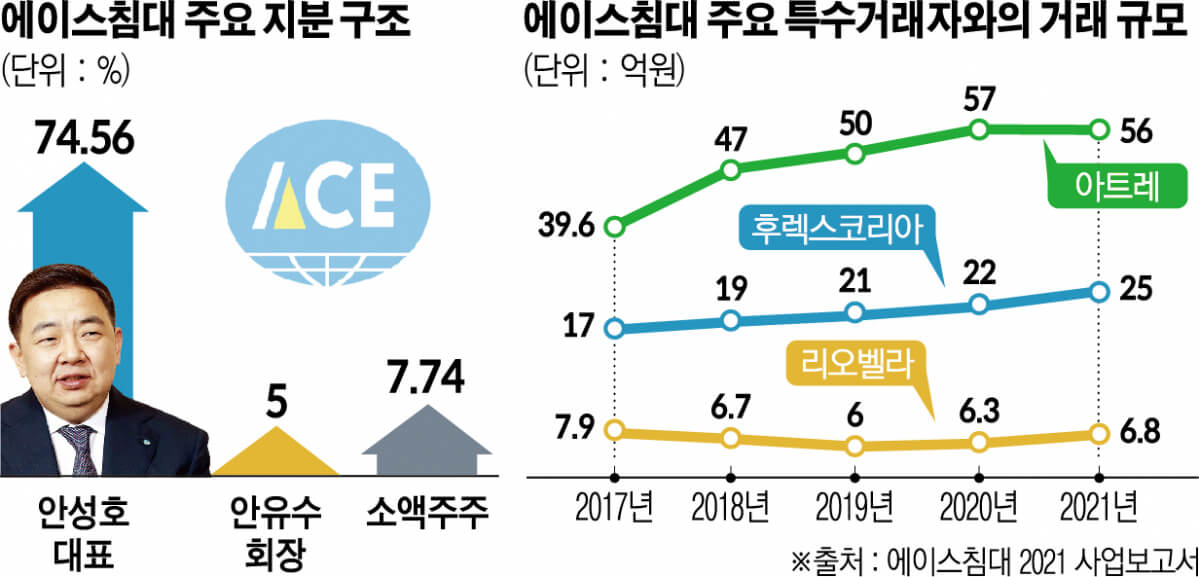
A peculiar thing about Ace Bed is that even if it wants to return capital to shareholders, it is hard to do so. The owner family holds 80%, and with Ace Bed holding 5% treasury stock, that comes to 85% (2024.12 Business Report, Matters Concerning Shareholders). In 2022, the free float ratio fell to around 10%, and the stock was actually designated as a managed item (News Space, 2025-02-18).
In 2023, nearly KRW 8 billion was paid for executive compensation and the like, an excessive figure relative to operating profit. However, upon investigation, founder and Chairman Ahn Yu-su incurred a one-time retirement payment of KRW 6.5 billion upon stepping down as president, and since then no executive has received compensation of KRW 500 million or more (2023.12 Business Report, Executive Compensation, etc.).
In 2023, transactions with Atre, a related party of the representative's family, were excessive enough to reach 20% of total purchases, but such cases have not occurred since 2024 (2023.12·2024.12 Business Report, Transactions with Major Shareholders, etc.).
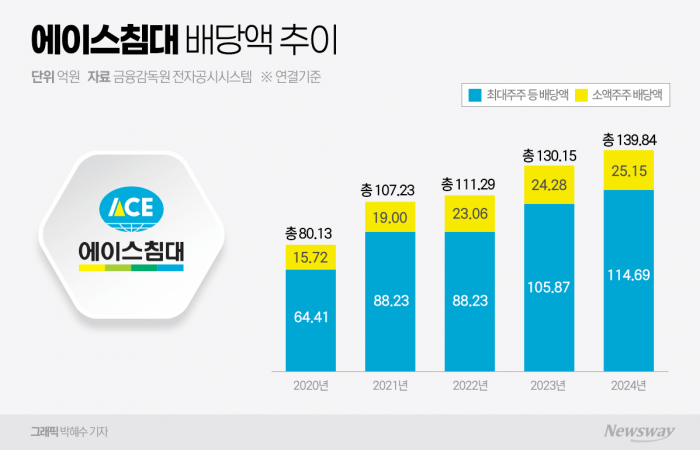
Some criticize the owner family for throwing a high-dividend feast, but in fact, with minority shareholders' stake so low, it is only natural for the owner family to take more. That is capitalism. The owner family even pays differential dividends, taking a smaller amount (News Space, 2025-02-18).
Why not convert to a private company?
From Ace Bed's perspective, converting to a private company would be far more advantageous. After all, minority shareholders' stake is low, and it is already mindful of its external image, even going so far as to implement differential dividends. It has no need to raise funds from the stock market, and further share buybacks are impossible for the company. Ultimately, I believe the biggest reason is management succession.
If Ace Bed paid gift tax at fair value, it would need a huge amount of money, but by gifting listed shares trading at a level far below PBR, it can save considerably on taxes. In 2023, 2% each was gifted to the eldest and second sons (Statement of Major Shareholdings, 2023-05-18), and the succession process is still ongoing. It is truly a textbook example of the Korea Discount. The eldest son joined the company in 2023, and with the CEO saying he will retire within eight years, the stock price may be hard pressed to surge until this succession process is over. But for long-term investors, it is a period they can easily endure. Ra Deok-yeon, who caused the SG stock manipulation scandal, said, "I'll outlive the old major shareholder. In the end, if we hold on, we get to eat it all."
Other matters
- The wholly owned subsidiary Ssulta Korea has been accumulating losses ever since it was acquired in 2020 (2024.12 Business Report, Status of Consolidated Subsidiaries). It seems they created a matrix specialist company to take on Zinus' position, but it is not doing as well as expected.
- It is a sibling company to competitor Simmons Bed.
- It is the largest shareholder of Sports Toto with a 35% stake (2024.12 Business Report, Investments in Other Corporations). However, Sports Toto remains in constant losses.
Footnotes
Related posts
The High-Dividend Trap
'High-dividend' stocks are not always a good choice. A high dividend payout ratio means lower long-term growth, and receiving dividends every year eliminates the tax deferral effect. Caution is needed because the dividend may not be sustainable or the company may have low growth potential.
Is Trump Really a Successful Businessman President? (Feat. 6 Bankruptcies)
Trump has packaged himself as a successful businessman, but in reality he has experienced six bankruptcies, and most of his assets were inherited from his father. He repeatedly faced crises through excessive leverage and reckless investments, and in 2024 faced yet another crisis due to inflating his assets.
No-Capital Acquisition and the Youngpoong Paper Incident
In 2023, Daeyang Metal acquired Youngpoong Paper with virtually no capital, and afterward Youngpoong Paper announced its entry into secondary batteries, sending its stock price soaring. However, excessive valuation relative to earnings and suspicions of stock manipulation emerged, and after the investigation the stock crashed. The damage was passed on to retail investors and securities firms.