
Is Trump Really a Successful Businessman President? (Feat. 6 Bankruptcies)
To us, Trump is famous as someone who went from successful businessman to candidate for president. But was he truly successful in business?
Is He Really a Successful Businessman?
Is Trump really a successful businessman? He tries hard to present himself that way, but in reality he has experienced bankruptcy six times. He also received his father's help at key moments. Trump inherited more than $400 million from his father, Fred Trump, but according to Forbes, his current assets are only about $500–700 million. Fred Trump died in the late 1990s, and 25 years later, his assets have only grown by about 20%. If he had simply invested the assets he inherited from his father in the S&P 500, it would be worth 52 billion1 dollars today. Even by a conservative calculation, if he had invested only after his father's death, it should be at least 2 billion2 dollars.
Why Did He Keep Going Bankrupt?
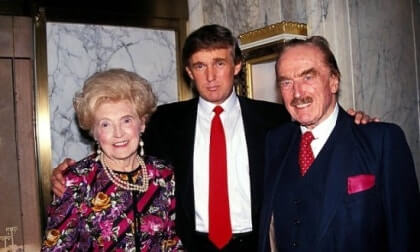 Mother Mary Anne Trump (left), Donald Trump (center), father Fred Trump (right)
First, Donald Trump's father, Fred Trump, had a very conservative investment style. He valued practicality over flashiness, focusing mainly on rental housing on the outskirts of New York for middle- and working-class tenants rather than luxury homes, and entered public projects based on government subsidies to minimize risk. He also cut costs by carrying out construction directly through his own construction company. Fred considered Manhattan, the heart of New York, to be a high-risk, high-return investment and avoided it.
If Trump had continued to expand his business the way his father did, he would have lived without major ups and downs. But his personality did not allow it. Trump preferred flashy, glamorous brands and bold leverage strategies. He took on excessive leverage, focusing on iconic luxury properties in Manhattan. And because he targeted the upper class, he concentrated on the "Trump" brand bearing his own name. Trump Tower, Trump International Hotel, and Trump National Golf Club are the results.
Four of the six bankruptcies were caused by excessive leverage and cash flow mismatches. The pattern was either buying brands with excessively expensive premiums or relying on a dominant casino market position and over-leveraging, only to fail after regulatory changes, or neglecting reinvestment in facilities even while making profits and then failing. He also raised funds at high interest rates based on an optimistic belief in his own name.
Trump Was on the Brink of Bankruptcy Until Recently
In 2024, Trump faced a crisis in which he had to post 600 billion won for an appeal over fraud allegations stemming from excessive asset inflation3. To raise the bond, he contacted dozens of insurance companies and surety companies, but was turned down by all of them. Then Trump listed the social media company he had created through a SPAC and raised $1 billion.
Who Supported Trump?

The cryptocurrency camp and the Musk side supported Trump with consulting fees. Just by looking at the donor list, you can see why Trump supports Elon Musk.
The Trump Family's Cryptocurrency Industry
Eric Trump recently claimed in an interview with Fox Business that JP Morgan, BoA, Capital One, TD Bank, and FRC abruptly closed the Trump family's accounts, and that this was due to pressure from the Biden administration.
He said, "The Biden administration's judicial attacks are unbelievable. But that does not justify banks canceling customers' accounts because of their political views," adding, "Capital One, Chase, Bank of America, TD Bank, and First Republic all treated us the same way." He continued, "Until every bank started canceling us for no reason, I hadn't even thought about entering the cryptocurrency world. We were attacked only because our father is a politician."
The Trump family saw all their accounts frozen and banks shunning them during the 2024 lawsuit, and felt they needed an alternative. So they became more determined to enter the Cryptocurrency industry.
Conclusion
Miller, who led The Apprentice's marketing team at the time, confessed, "To promote the show, we created the story that Trump was a very successful businessman. It was bluster, and highly exaggerated," and "We even made up false stories to make Trump look more successful than he really was."
According to Miller, the former president had already gone through four bankruptcies before the show was produced, and went bankrupt at least two more times during the 14 seasons. Miller said, "The famous boardroom where Trump fired contestants was actually a TV studio set," adding, "Trump's real boardroom was too old and shabby for television."
Miller also revealed, "We blasted 'fake news' across America like a snowstorm. We never imagined that a show depicting Trump as a successful businessman would help lift him into the White House."
Michael Bloomberg, founder of Bloomberg, once said, "You should vote for Trump because he is a great businessman? Is that really true?" Trump is not as successful a businessman as people think. Rather, he is someone who needs the image of a successful businessman.
Footnotes
Related posts
Ace Bed Company Analysis
Ace Bed is a premium bed brand focused on the domestic market, with a very stable financial structure and debt-free management, maintaining a high dividend yield (5.71%). ROE is decent, but capital efficiency is low due to excessive cash holdings. The owner family's stake exceeds 80%, and maintaining the listing appears to be largely for management succession. Short-term surges are difficult, but long-term investment appeal still exists.
The High-Dividend Trap
'High-dividend' stocks are not always a good choice. A high dividend payout ratio means lower long-term growth, and receiving dividends every year eliminates the tax deferral effect. Caution is needed because the dividend may not be sustainable or the company may have low growth potential.
No-Capital Acquisition and the Youngpoong Paper Incident
In 2023, Daeyang Metal acquired Youngpoong Paper with virtually no capital, and afterward Youngpoong Paper announced its entry into secondary batteries, sending its stock price soaring. However, excessive valuation relative to earnings and suspicions of stock manipulation emerged, and after the investigation the stock crashed. The damage was passed on to retail investors and securities firms.