
The Story of the 2008 Oil Shock
I recently watched a video by Professor Kim Ki-bum on peak oil

I remember peak oil showing up in my textbooks when I was young too. It said wars would break out in the future to secure energy. Below is the 1956 forecast of crude oil production (in red) and the actual production through 2015 (in green).
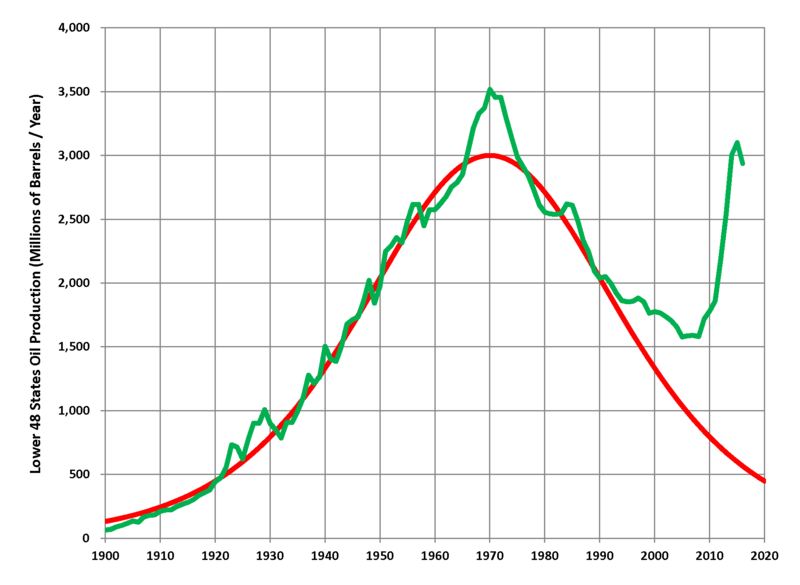 Red is the oil production forecast from 1956 vs the green line is actual production through 2015
Even after 2015, oil production and reserves have kept rising. It is quite different now, but in the 2000s peak oil theory was everywhere.
Let us go back to the mid-2000s and look at the situation at the time.
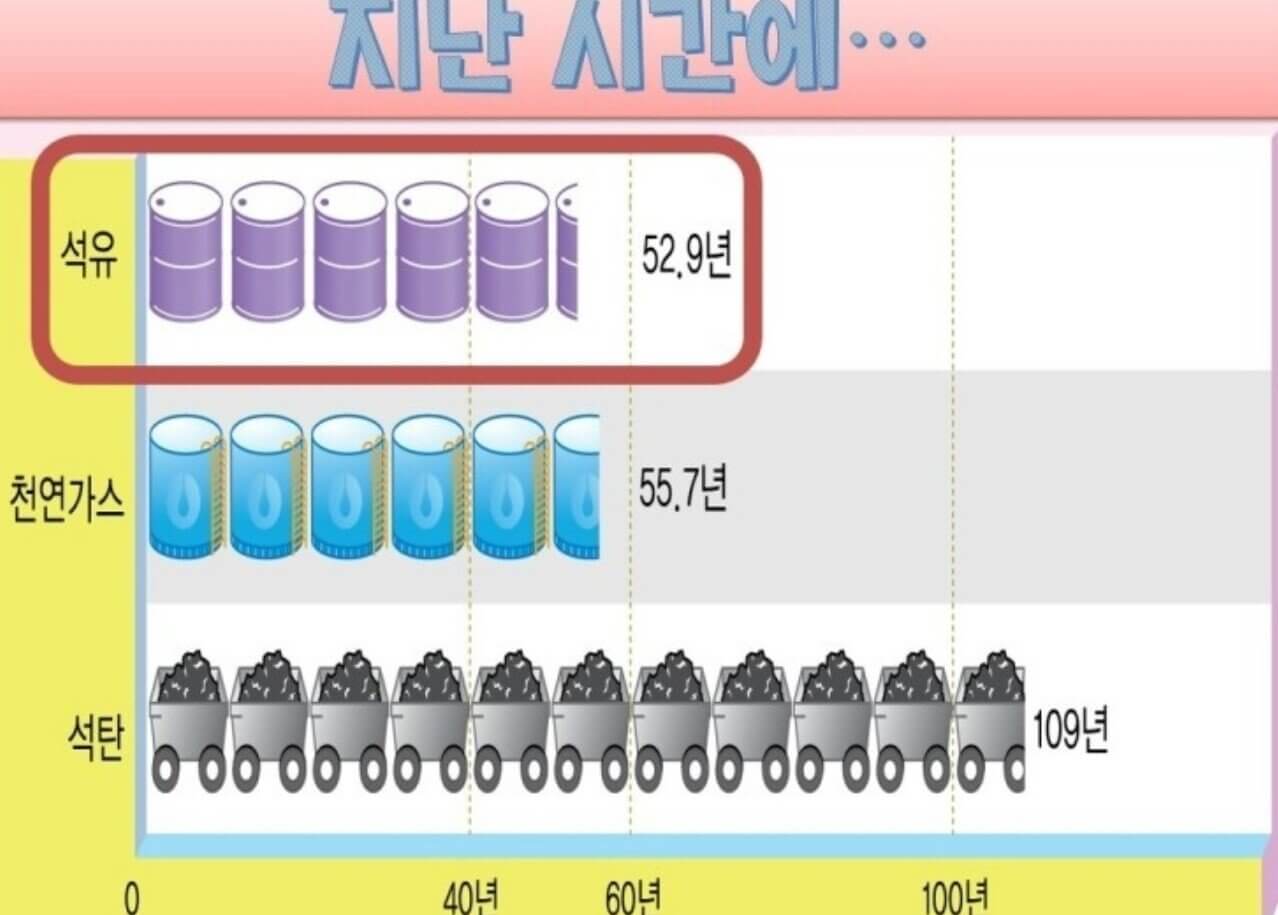
By country, the period over which oil can still be extracted is 10 years for the United States and 20 years for Russia. Middle Eastern countries have reserves close to 100 years, but China and India are increasing consumption rapidly and shortening the average lifespan of oil.
June 22, 2005 KBS The Korea Economic Daily
As gasoline prices in the United States climb to record highs day after day, the 'oil depletion crisis' argument is rearing its head again. Kenneth Deffeyes, professor emeritus at Princeton, pointed out in his recent book (Hubbert's Peak) that "world oil production will peak between 2001 and 2010" and that "the recent surge in oil prices may be a harbinger of a grave crisis." David Goodstein, a professor at Caltech, also warned in his book 'Out of Gas' that "oil production will peak within 2010 and after that there is a strong chance it will decline forever."
April 2, 2006 The Korea Economic Daily
The won-dollar exchange rate was also really low at the time.
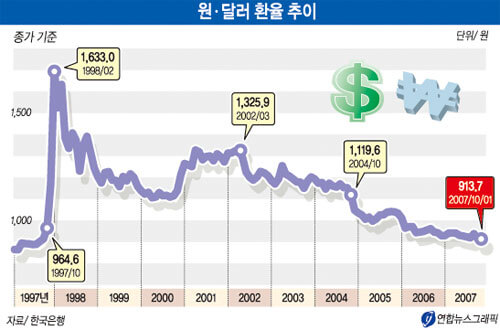
It was a weak-dollar period. In 2006 KIKO was in fashion, the view that the twin deficits would weaken the dollar further was everywhere, and Buffett too was explaining his concerns about the dollar in an article and selling his dollar position. In Korea as well, selling of dollar forwards continued, and people dumped everything at the '950' won level.
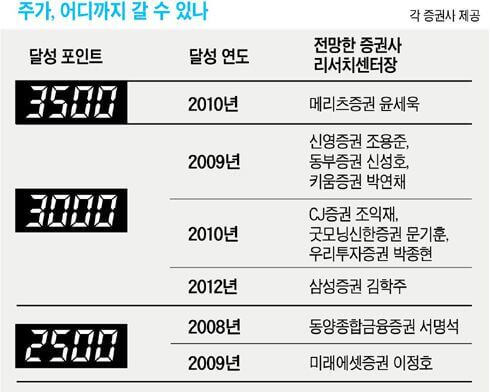 "It will go to 2,500 at the least and 3,500 at the most" Chosun Biz article, July 25, 2007
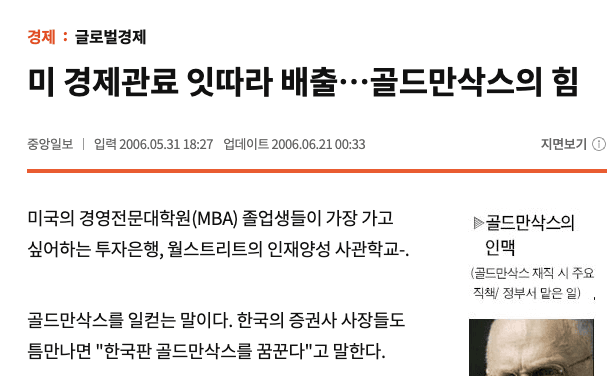
It was a world where brokerages talked about 3,500, a level the index has not reached even now. Around 2006, Goldman Sachs managing director Arjun Murti forecast that crude could break 100 dollars.
Analyst Arjun Murti pointed out that "the crude market has entered the early stage of a price surge, in step with the global economic recovery." From this state, as time passes, it reaches what is called the 'Super Spike' stage. Once it reaches that stage, prices surge again and again and demand for crude, unable to bear it, plunges.
Supply fears spread, including doubts about OPEC's limits = the international crude market has lately been filled with a growing view that OPEC has hit its limits. With the weakening of OPEC's spare capacity to raise output and to adjust the market, OPEC accounting for 40% of world oil supply, the buffer against an oil shock is gone.
April 2, 2005 Maeil Business Newspaper
The logic was simple. The world economy was recovering, OPEC output could fall, and a hurricane could hit refineries. OPEC responded to this.
Adnan Shihab-Eldin, acting secretary general of the Organization of the Petroleum Exporting Countries (OPEC), said on the 10th that international oil prices would not surge to 105 dollars a barrel. On Goldman Sachs' March 30 forecast that oil would rise to 105 dollars a barrel, the acting secretary general said, "we do not see prices going that high." He stressed that "prices right now are high enough and may even be excessively high," and that "OPEC will bring them down to an appropriate level."
April 11, 2005 Yonhap Infomax
In a special report titled <Is the Era of 100 Dollar Oil Coming?> on December 17, the Korea National Oil Corporation drew on domestic and foreign forecasts to raise problems with peak oil theory and the oil depletion argument. On the fear of oil running out within 40 years, the report dismissed it as "nonsense close to comedy," saying "40 years is simply the current proven reserves of 1.2 trillion barrels divided by current production of 30 billion barrels, and it does not definitively indicate the point of resource depletion." It pointed out that proven reserves do not include the increase in recoverable volumes that new discoveries and technological progress make extractable when they previously were not.
The oil corporation's logic was more accurate. On top of that, it was a report written with advice from OPEC, the very party cited as the main cause. But a few weeks later, crude prices began climbing again.
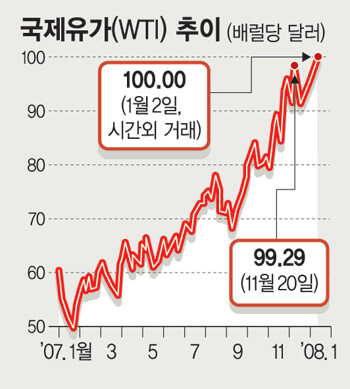
In 2008 oil touched 100 dollars.
International oil prices have passed the 120 dollar a barrel mark and are setting record highs day after day. Analysis is emerging that the era of 200 dollar oil could arrive sooner than expected.
The fundamental cause of the strength in oil is that consumption in emerging countries such as China and India is surging while supply cannot keep up. Externally, the weakness of the US dollar and heightened geopolitical risk in Nigeria, Iran, and elsewhere are also fueling the rise. Goldman Sachs, regarded as the sharpshooter of oil forecasting after predicting the era of 100 dollar oil last year, forecast that international crude prices would rise to 150 to 200 dollars a barrel within the next six months to two years
May 7, 2008 - The Korea Economic Daily
Oil suddenly touched 100 dollars and everyone started praising Goldman Sachs
The man in question is Arjun Murti (39), an oil analyst at Goldman Sachs. He had been warning since 2004 that international oil prices would pass 100 dollars a barrel. He is now called 'the sage of oil prices', but back then his was a 'lonely voice'. Other analysts scoffed at his forecast. At the time international oil was around 40 dollars a barrel. Prices would show an uptrend and then turn back down as soon as supply rose a little. But within a few years his prediction became reality. As his forecast proved exactly right, Murti has become famous enough that the market now swings on a single word from him.
May 23, 2008 - The Dong-A Ilbo
Everyone started praising him. But it made no sense. Every premise he had laid out turned out to be wrong. OPEC did not cut output, and far from the economic recovery he talked about, a worldwide depression arrived with the The Subprime Mortgage Crisis. And the hurricane damage never came either.
Goldman Sachs raised its forecast for international oil prices and said that in the worst case they could rise to 200 dollars a barrel. On the 7th, Goldman Sachs said this while raising its oil forecasts for this year through 2010 by an average of 15 dollars, on the basis that crude had passed 100 dollars a barrel even with no unusual disruption in the market recently and with the US economy appearing to be in recession. Goldman Sachs raised its average price forecast to 95 dollars this year, 105 dollars next year, and 110 dollars in 2010.
March 8, 2008
As oil rose and peak oil theory gained strength, a boom in alternative energy broke out. Every related stock, from solar to microbes, started jumping.

With international crude prices on a high-price march, a dreamlike method that converts plant waste and food scraps into oil has been developed in the US state of California and is on the verge of going to market.
An official US government survey has found that 90 billion barrels of crude, enough for humanity to use for three years, are buried in the Arctic region
Saying the oil in the Arctic had to be drilled, icebreaker stocks and offshore plant stocks started running. As everyone knows, 13 years later the shale revolution left oil overflowing and brought the negative oil price episode. It was not only the press that fanned all this. Oil depletion also shows up in the reports of the economic research institutes of Korea's big conglomerates.
Korea's major economic research institutes also began raising their international oil price forecasts one after another.
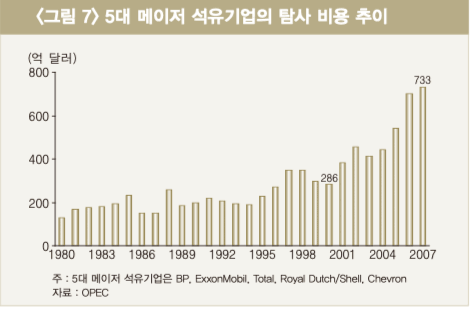
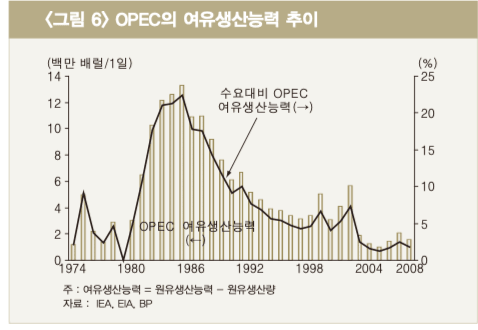
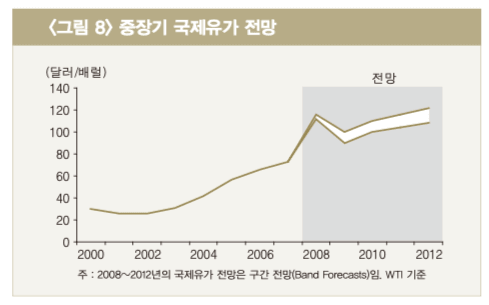

Now even the story that Saudi reserves were actually a third of the stated figure started going around. Korean public opinion began converging on the idea that we had to prepare for the era of 200 dollar oil. To give a sense of how far it went
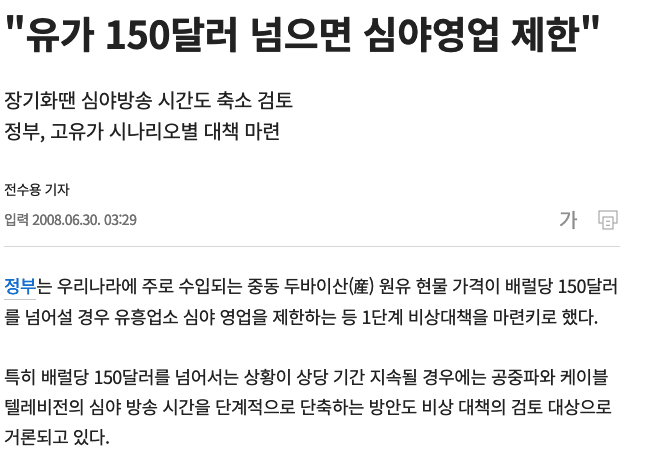
Above 150 dollars, late-night business hours would be restricted; above 170 dollars, private vehicles would run on an odd-even or every-fifth-day system, and even fuel rationing for vulnerable groups was included in the government plan. At the time the whole world treated 100 dollar oil as the new normal and everyone started buying and stockpiling fuel.
What Happened Afterwards

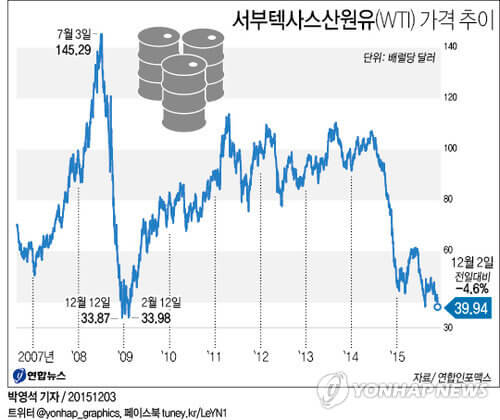
Why did Goldman do this? At the time WTI futures were traded through the New York Mercantile Exchange (NYMEX), and since half of the trading value went through Goldman Sachs, Goldman's fee income grew insanely. Prices dropped vertically from 145 dollars to 33 dollars, and with that enormous volatility Goldman Sachs collected huge fees. Later, testimony began to emerge that Oil Depletion Statistics Manipulated Under US Pressure. How was something like this possible?

Wall Street forecasts should go in one ear and out the other.
Related posts
Ace Bed Company Analysis
Ace Bed is a premium bed brand focused on the domestic market, with a very stable financial structure and debt-free management, maintaining a high dividend yield (5.71%). ROE is decent, but capital efficiency is low due to excessive cash holdings. The owner family's stake exceeds 80%, and maintaining the listing appears to be largely for management succession. Short-term surges are difficult, but long-term investment appeal still exists.
The High-Dividend Trap
'High-dividend' stocks are not always a good choice. A high dividend payout ratio means lower long-term growth, and receiving dividends every year eliminates the tax deferral effect. Caution is needed because the dividend may not be sustainable or the company may have low growth potential.
Is Trump Really a Successful Businessman President? (Feat. 6 Bankruptcies)
Trump has packaged himself as a successful businessman, but in reality he has experienced six bankruptcies, and most of his assets were inherited from his father. He repeatedly faced crises through excessive leverage and reckless investments, and in 2024 faced yet another crisis due to inflating his assets.